HOME  |    SEARCH  
Image
All about our Private Sector Development practice
 
Enterprises in emerging markets face multiple challenges: international competition, poor business policies, and products ill suited to the market. Working with both business and government, Private Sector Development assists firms and industries in developing countries as they generate sales, investments, and jobs that stimulate economic growth and reduce poverty.  

» More


More about our work in Private Sector Development
 

IT courses click open new windows in Moldova

Low-tech solution helps Afghan wool company thrive

Burden of business inspections eased in Bosnia-Herzegovina

Midwives expand access to safer deliveries in the Philippines

Moroccan olive processor finds new markets in Europe

 
» More
 

More about our work in Latin America and the Caribbean
 

Panamanian project trainees contribute to search and rescue in Haiti

Chemonics' response to the earthquake in Haiti

Literacy program strengthens civic participation in Bolivia

Chemonics project wins USAID award for innovative financing

Peruvian farmers go from local markets to international buyers

 
» More


Private Sector Development Job Listings

Chief of party

Community organizer and SME development expert

Community-level economic development expert

Construction engineer and housing maintenance expert

Grants manager

  Developing pathways from poverty in Peru

Andean highlands, Peru — Peruvian growers of red quinoa are making their first sales in the United States thanks to a major project that seeks to build “economic corridors” in their country.

Over the next 12 months, the restaurant supplier Quinoa Corporation of California will buy 160,000 lbs of the Pasancaya quinoa variety from growers in the Puno corridor. “This is the first-of-its-kind import of red quinoa into the United States and amounts to $80,000 to $100,000 in farm value,” said Jim Krigbaum, marketing specialist for the PASOS project managed by Chemonics International.

Chemonics first put the Quinoa Corporation and quinoa producers together several months ago, resulting in a trial shipment worth $18,000. The final deal was struck last month at a restaurant association trade show in Chicago.

Red quinoa is grown in the highlands of Lake Titicaca at 15,000 ft. The altitude creates a dense, high-protein “pseudo-grain,” which is a seed resembling couscous. Rich in amino acids, “quinoa is what kept the Incas alive in the barren highland areas,” said Krigbaum.

The Quinoa Corporation is the number one U.S. retailer of the seed, which until now came exclusively from Bolivia and consisted only of the white quinoa. “Chefs will like the unique, aesthetically pleasing appearance on the plate of the Peruvian red quinoa,” Krigbaum said.

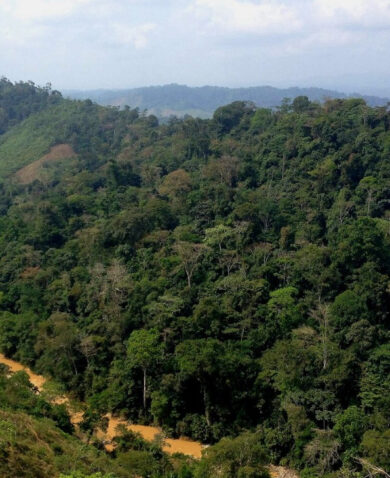
The PASOS project provides technical know-how to help entrepreneurs and small producers increase their sales. All are located in “economic corridors” in remote jungle and Andean highland areas. Economic corridors are areas delineated by the movement of goods and services — along highways, rivers, and trade centers — from remote locations to secondary cities.

The project runs 10 economic service centers in these corridors, six in the Andean highlands and four in the Peruvian jungle. Since September 1999, when the project began, net sales from these areas have grown from zero to $2.1 million.

“Demand and supply move the world,” said Oscar Rizo-Patron, PASOS deputy chief of party. “We concentrate on activities that have tangible demand.” The centers are developing partnerships in the private sector that will endure well after the project ends in 2003, he said.

“The centers encourage individuals and small business owners to join associations for greater exchange of information,” said Rizo-Patron. “Others take note and want to follow suit. It increases the entrepreneurial spirit.”

In the jungle corridor of Jaen, a PASOS center helped an ice cream company improve its packaging and expand its line. In Cajamarca, the centers helped organize a stable supply of alubia beans for buyers in Spain, Italy, and Mediterranean countries. With assistance from nongovernmental organizations, producers obtained fertilizer, seed, and management assistance, leading to $25,000 in sales since September 1999.

A PASOS center in Huancayo helped Teresa Romero, a businesswoman, find markets for pineapple. “We put her in contact with a processing plant,” said Rizo-Patron. “We helped her set terms, prices, and conditions, find trucks and the right boxes and cartons to protect the fruit during shipment. Now she has an established business, providing top grade pineapple to the plant, and she sells the rest wholesale to local supermarkets.”

Romero’s business has generated $56,000 in sales over the last 18 months. New income from her business and others has strengthened the economic infrastructure in the Jaen corridor, creating a reliable supply channel to market.

“We don’t give money, credit, or equipment,” said Rizo-Patron. “We approach the business or individual and offer to assist them with solving their business problems. We look at the market for their products, what they need to process their crops.”

The Chemonics project conducts market studies, collects information on interested companies, and helps producers prepare their products for larger markets. The centers also serve as clearinghouses for market information and technical experts. The U.S. Agency for International Development recently increased the contract value from $4.9 to $14.5 million. [Print Version]